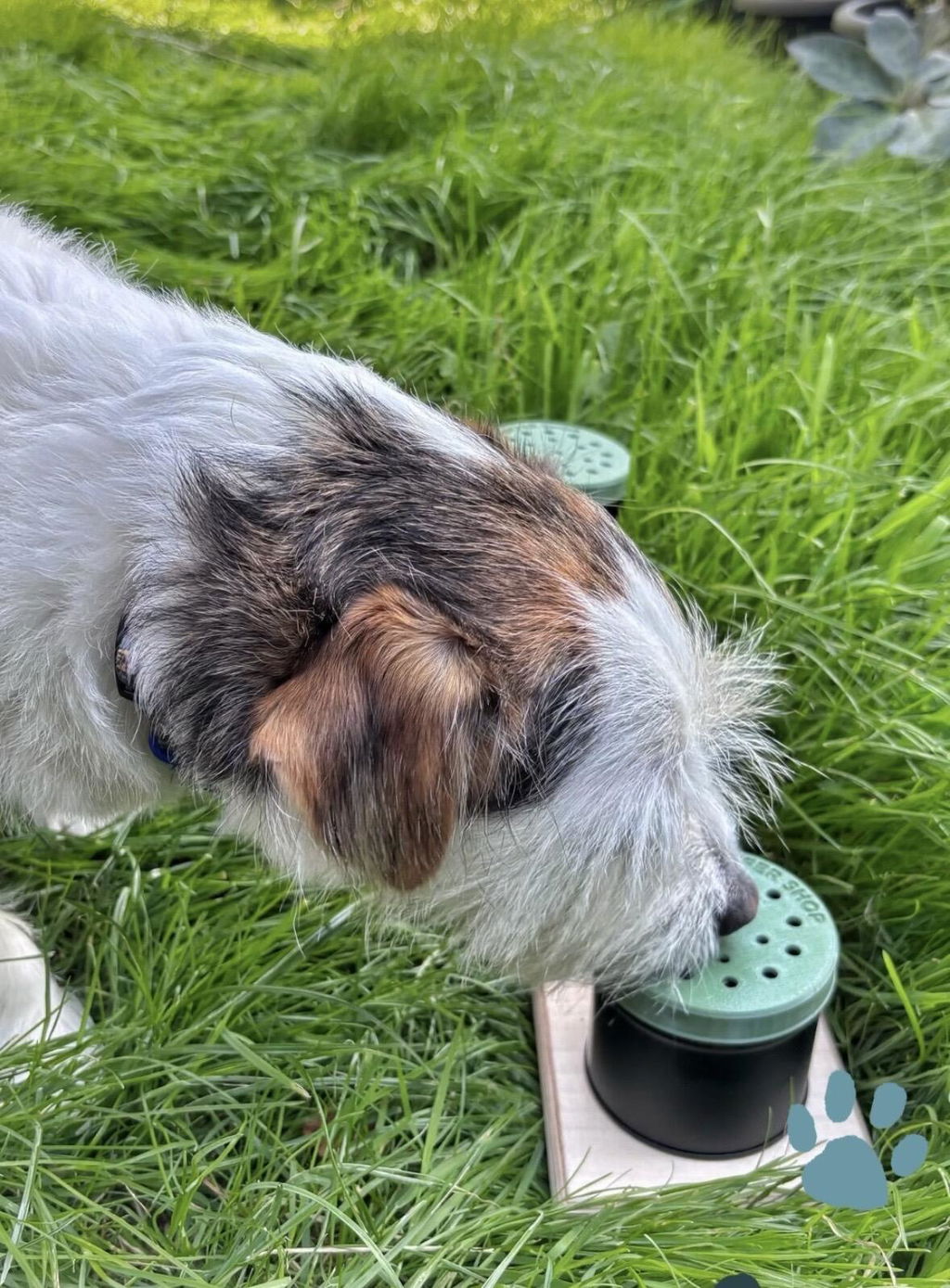
Introduction to Pot Run Set-Ups
Welcome to our guide to Pot Run Set-Ups in Scentwork designed for the pet dog handler. Whether you're brand new to scentwork or polishing your skills for competition, this guide will help you and your nosey dog understand the art of container searches.
Pot runs in Scentwork (also called container searches or line-ups are used to build clear, accurate odour recognition. They help confirm that your dog can correctly identify a target odour among identical containers using scent alone: no cheating with visual cues, patterns, or sneaky glances at you for hints!
They're not about speed or difficulty. Think of them as your dog's "spelling test" for scent. Can they truly recognise and commit to the target odour they have learned?
🐶 Did you know?
Dogs trained for medical or detection work often use lineup-style searches to hone their skills. In professional scent detection work, dogs are regularly presented with blank runs - sets of identical containers where only one, if any, contains the target odour. This setup trains the dog to discriminate the target scent from background or control samples, and helps reduce false positives by teaching the dog not to alert randomly when nothing is present.
How are pot runs related to Odour Recognition Trials (ORTs)?
Pot runs follow the same core principles as formal Odour Recognition Tests. UK organisations like Scentwork UK use container searches in their "Bags, Boxes and Containers" elements at trials, whilst the National Nosework Association (NNA) uses Odour Recognition Tests to measure the dog's understanding of the target odour and their ability to work methodically to find hides Thenationalnoseworkassociation.
The aim is always to assess and strengthen your dog's ability to discriminate a specific odour from blanks or distraction odours. Clean, consistent setups help ensure your dog's response reflects genuine odour understanding rather than environmental influences or accidentally reading your body language. Yup this happens more than you think!
What materials can I use for pot runs in Scentwork
The beauty of pot runs in Scentwork is their versatility! You can use almost any identical containers, including:
- Cardboard boxes (storage boxes, shoe boxes)
- Plastic containers (food storage tubs, 110mm soil pipes from screwfix)
- Fabric bags (canvas drawstring bags, rucksacks, old bags even suitcases)
- Stainless steel pots or tins (food storage containers, camping pots)
- Metal tins (biscuit tins, coffee canisters)
- Terracotta pots (upturned plant pots)
- The Sniffer System (metal pots with vented plastic lids)
- The Sniffer Pot and Stand (stainless steel vented pots in rugged stands)
The key is that all containers in your line-up should be identical so your dog can't use visual cues to pick the hot one (article containing odour).
What is a "Blank" Container?
A blank is simply an empty, unscented container. In a pot run, you'll have several blanks and one "hot" container (the one containing your target odour). The dog's job is to find the hot one among all the blanks. Easy for us to understand, but it requires real scent discrimination skills from your dog!
Distraction odours: For more advanced dogs, you can add distraction odours to replicate real life where other "interesting" odours can interfere with a dog searching. Distraction odours should be introduced fairly early, always working at your dog's level and setting them up for success. This reduces the frustration that can happen when the dog becomes confused, not understanding the job in hand, often leading to throwing false indications.
Odours used in distraction training can be the gloves we use, food, or even other dog scents.
The Starting LIne...
At the start line: Position both you and your dog facing the line-up of containers. At the start line, restrain the dog a little by holding their harness or collar, building their focus and desire to drive forward on your release or search cue. This helps build anticipation and commitment to the task.
The release: Pause, don't rush! Take time at the start line before releasing your dog or cueing them to search. Your dog will be taking in the visual picture of the search area and the scents, and may well pick up the target odour at the start line
Give your search cue (such as "find it" or "search") and release your dog to begin working independently. Video starring the lovely Lani who loves Scentwork!
Can I teach odour from scratch using pot runs?
Yes you can - but the caveat here is that pot runs work best once your dog already has basic odour recognition. They've learned what the target odour smells like and that finding it equals good things happen!
We recommend starting with simple scent discrimination using two containers: one "hot" containing target odour, and one "cold" with no odour. Then progress to three or more as your dog's understanding and confidence develop. Pot runs are most effective for confirming and strengthening odour understanding, rather than introducing odour for the first time.
How many containers should I start with?
Start with just to 3-4 containers, then expand to 5 -10 once they're reliably finding the hot container. This creates a more realistic challenge similar to competition standards.
We recommend having 8-12 containers in your training kit so you can progress through these stages. You can always add more as your dog's skills develop!
Best Practice - thinking about contamination..
Human scent transfer is one of the most common sources of contamination in pot runs. Our hands are surprisingly smelly to dogs! To reduce this, we recommend:
- Handling containers with gloves when setting up
- Setting up (blank) containers first, then the scented (hot) one last
- Allowing the odour to settle before running your dog
- Being mindful of airflow and where odour may pool, such as near walls, furniture, or other solid objects
- Consider using non-permeable containers - cross contamination and clarity are easier to manage with materials such as stainless steel, hard plastic, or other metals.
- Alternative approach: You may choose to deliberately place odour on all containers to reflect real-life searching, where background and residual odours are always present. This can be a useful variation once your dog has clear odour recognition, but it should be an intentional training choice rather than unintended contaminaton
Non-permeable materials, such as stainless steel, hard plastic, and glass, are easier to clean and manage between sessions, giving you a cleaner, more consistent odour picture. That said, cardboard boxes and bags are brilliant for beginners or introducing variety! They're inexpensive, readily available, and perfectly adequate for early learning. Many handlers use a mixture: cardboard for fun practice, metal for precision training
How do I know which container is hot if they all look the same?
This is the eternal handler’s dilemma. In pot runs, containers need to look identical to the dog so they can’t use visual cues. We want them relying on their superpower nose, not their eyes.
Of course, handlers still need a way to keep track. I was forever getting myself muddled, so we built in a simple fix. Each 5-pot and 20-pot Sniffer System now includes one pot with a contrasting fine red rim on the lid - allowing you to identify the hot pot without altering the dog’s learning picture.
The JohnPod™ system by Enigma Canine uses subtle colour coded "pods" to help handlers differentiate between "hot" and "cold" scentwork containers.
Some handlers prefer to use numbered stickers along the bases, or marker-pen dot on the containers while others simply remember the pot’s position in the line-up.
Any of these approaches are fine, as long as the visual reference is for you and not giving the dog extra information.
A few practical notes to finish..
When working pot runs, it’s best initially to reinforce the behaviour of odour recogniton at the odour source. This gives clarity for the dog by reinforcing commitment to the target odour itself. In the early stages, delivering a treat or toy beside the container works perfectly. As your dog becomes more confident, you’ll often find you can stand back and simply observe them working. This has the added benefit of reducing any disruption to the odour picture and removing unintentional body cues we may not even realise we’re giving.
If your dog gets it wrong, don’t worry! Mistakes are not failures, they’re information. A wrong alert might suggest the odour picture needs adjusting, that contamination could be a factor, or that the exercise needs simplifying for a session or two. It can also highlight moments where we, as handlers, may be influencing the search more than we intend, Take a breath, reset the setup, and try again. Every good sniffer dog has learned through moments like these.
Short, successful sessions of just a few minutes are far more valuable than long, repetitive drills. Many handlers include pot runs two or three times a week as part of their wider scentwork training, using them as a check-in on odour understanding rather than a daily routine. Keep sessions light, purposeful, and always end on high for your dog!
Used this way, pot runs for scentwork training are a fun and confidence-building tool that can be used inside and outside for both dogs and handlers.
If you’d like to explore pot runs and scentwork training in more depth, Canine Scentwork Academy run a supportive online course designed for pet dog handlers at any stage of their scentwork journey. The course covers the foundations of scentwork alongside practical guidance, including everything you need to confidently run line-ups at home.
You can find out more about their Sniff It Out course here:
Enjoy this article? You might like this article about Using Pot Runs in Scentwork
Kate Hart
Written by Kate Hart, scentwork instructor and founder of The Sniffer Shop. Kate supports pet dog handlers in developing clear, odour-led learning through thoughtful training setups and practical scentwork equipment.